
Two villas, the same ZIP code, a similar living area—and yet their potential selling prices are worlds apart. One is set back behind mature trees; its floor plan is designed to maximize natural light, and the garden provides privacy. At the other, traffic noise comes from the street behind the hedge; on the upper floor, load-bearing walls compartmentalize the rooms; and the supposed lake view will disappear as soon as the neighboring lot is developed.
Anyone looking to appraise a luxury property in Munich and Bavaria must therefore not simply multiply square meters by a comparable price. In the premium segment, value arises from a finely balanced interplay of location, rarity, architecture, legal certainty, and emotional appeal. By 2026, this precision will become even more important: Buyers will be more selective in their comparisons, scrutinize documentation more closely, and distinguish more consistently between costly amenities and lasting quality. The following twelve value drivers highlight what owners and prospective buyers in Munich, the surrounding area, and Bavaria’s sought-after retreats should look for.
How to Reliably Determine Value in the Premium Segment
A reliable appraisal begins with an uncomfortable realization: luxury is not a separate category. Even an extraordinary property is subject to the real estate market, its structural condition, and actual demand. However, these factors play out differently in the premium segment than they do for standard condominiums. A rare plot of land can increase the value disproportionately; an inconvenient access road can significantly limit it, even with marble bathrooms.
Professional appraisals therefore combine three perspectives. The sales comparison approach examines actually comparable sales, provided suitable data is available. The cost approach considers the land, the building, and construction costs, but only partially reflects the emotional willingness to pay for uniqueness. For rental properties, the income approach complements the analysis. No single method should be used in isolation. Especially for villas, penthouses, country estates, and historic homes, the numerical data requires a qualitative interpretation of the market.
For a planned sale, a well-founded market price estimate can serve as an appropriate basis. In cases involving tax, inheritance, or legal matters, however, a transparent market value appraisal prepared by a suitably qualified appraiser is typically required. Owners should therefore first determine the purpose of the appraisal.
A three-level analysis is helpful:
- Foundation: Property, micro-location, building rights, building condition, and usability.
- Premium factors: architecture, privacy, views, materials, technical quality, and history.
- Marketability: Rarity, target audience, competitive landscape, documentation, and timing of the sale.
Be sure to avoid double-counting. An unobstructed view should not be factored into the price in terms of location, scenery, and rarity all at once. Similarly, an expensive renovation does not automatically justify a price increase equal to the total cost of the repairs. What matters most is the added value that an informed buyer recognizes and is willing to pay for. Thus, any serious analysis begins where real estate value is created: right at the front door.
1. The micro-location: A few meters can make a world of difference
“Munich-Bogenhausen” sounds like a clear indication of value. In reality, even the next intersection can change the living experience. Is the house located on a quiet, established street or along a heavily trafficked thoroughfare? Does the garden face south? Are schools, restaurants, and green spaces accessible without the flow of people passing directly by the property? In the premium segment, it’s not just the address that counts, but how it fits seamlessly into everyday life.
The same applies to Nymphenburg, Herzogpark, Lehel, the Old Town, and select locations in Grünwald. On Lake Starnberg, factors such as access to the shore, slope orientation, sunlight exposure, and the actual line of sight are decisive. Around Lake Tegernsee, tourist traffic, the slope of the terrain, and seasonal noise can put an idyllic map view into perspective. In rural regions of Bavaria, accessibility, infrastructure, and the quality of the immediate surroundings are more prominent factors.
So be sure to explore the neighborhood at different times: on a weekday morning, in the early evening, and on the weekend. Open the windows. Walk along the path to the property. Check for any planned construction projects—don’t just look at the current condition. Even a flawless villa loses its appeal if delivery traffic dominates the mornings or if the trip back from downtown regularly becomes a test of patience.
Land value guidelines and local comparables provide a starting point, but they are no substitute for local knowledge. The key question is: What quality of life does this specific property offer? Only then is it worth taking a closer look at the property itself.
2. Property, Garden, and Private Outdoor Spaces
A large lot makes a strong impression in the property listing. It only becomes truly valuable when its size, layout, and intended use all align. A deep, secluded garden with mature trees can make a Munich villa truly distinctive. A similarly large plot on a steep north-facing slope, on the other hand, requires a lot of maintenance, gets less sun, and may have limited practical use.

Evaluate properties from multiple perspectives: How is the building situated on the lot? Is there room for a patio, pool, guest house, or private retreats? Do the topography and vegetation elegantly separate private areas from the street? Can vehicles be discreetly driven up to and parked on the property? Even the experience of arriving carries significance in the luxury segment. A grand driveway makes a different impression than a narrow ramp where every larger car has to maneuver.
The garden, too, is not merely a decorative afterthought. A landscape that has evolved over decades—comprising solitary trees, hedges, and carefully planned sightlines—cannot be recreated in a single season. At the same time, protected trees, easements, or utility rights may limit the design. In waterfront areas, additional considerations include flood control issues, riparian rights, setback requirements, and access regulations. The presence of a dock in a photograph does not necessarily mean that its use is legally guaranteed in the long term.
In a penthouse, the rooftop terrace serves as the lot. Here, what matters is usable depth, wind protection, load-bearing capacity, irrigation, privacy, and access from the living spaces. A 100-square-meter area with no shade and constant wind may be less appealing than a smaller, well-zoned terrace. Practical privacy trumps nominal size —and creates the setting in which architecture can truly shine.
3. Architecture, Style, and Historical Origins
Some houses reveal their character right at the front door. Proportions, materials, and sightlines all follow a single concept; nothing seems left to chance. Others simply collect expensive individual elements without developing a cohesive architectural language. Buyers in the premium segment often recognize this difference more quickly than technical descriptions might suggest.
A clear design philosophy, balanced proportions, and a harmonious relationship between the building and its surroundings all contribute to increased value. For historic villas, other factors include provenance, the degree of preservation, and documented renovations. Original doors, natural stone floors, stucco, or wood paneling retain their long-term value only if they are authentic, well-maintained, and functionally integrated. A prominent architect’s signature style can generate demand, but the name alone cannot remedy poor natural light or impractical floor plans.
Stylistic inconsistencies are particularly problematic. A sensitively modernized historic building can combine historical dignity with contemporary comfort. If, on the other hand, window divisions, roof shapes, and materials are altered without an overall concept, the house loses its identity. Even the most expensive kitchen can hardly make up for this loss.
The assessment includes construction plans, permits, lists of historic buildings, and a clear chronology of changes. For properties designated as historic landmarks, the unique character of the building presents opportunities but also requires realistic assumptions regarding renovation, maintenance, and energy efficiency improvements. Anyone seeking to appraise such a luxury property should therefore neither romanticize its history nor view it indiscriminately as a burden. Good provenance increases value when it is tangible, verifiable, and compatible with modern living. Whether this quality is preserved over decades, however, depends on the physical condition behind the facade.
4. Building Condition and Quality of the Renovation
A fresh coat of paint can be deceptive. Behind it may lie outdated wiring, damp structural components, or makeshift renovations. In the high-end market, such shortcomings carry particularly heavy weight because buyers don’t just factor in repair costs. They also take into account the planning effort, potential delays, and the uncertainty of whether the desired level of quality can even be achieved.
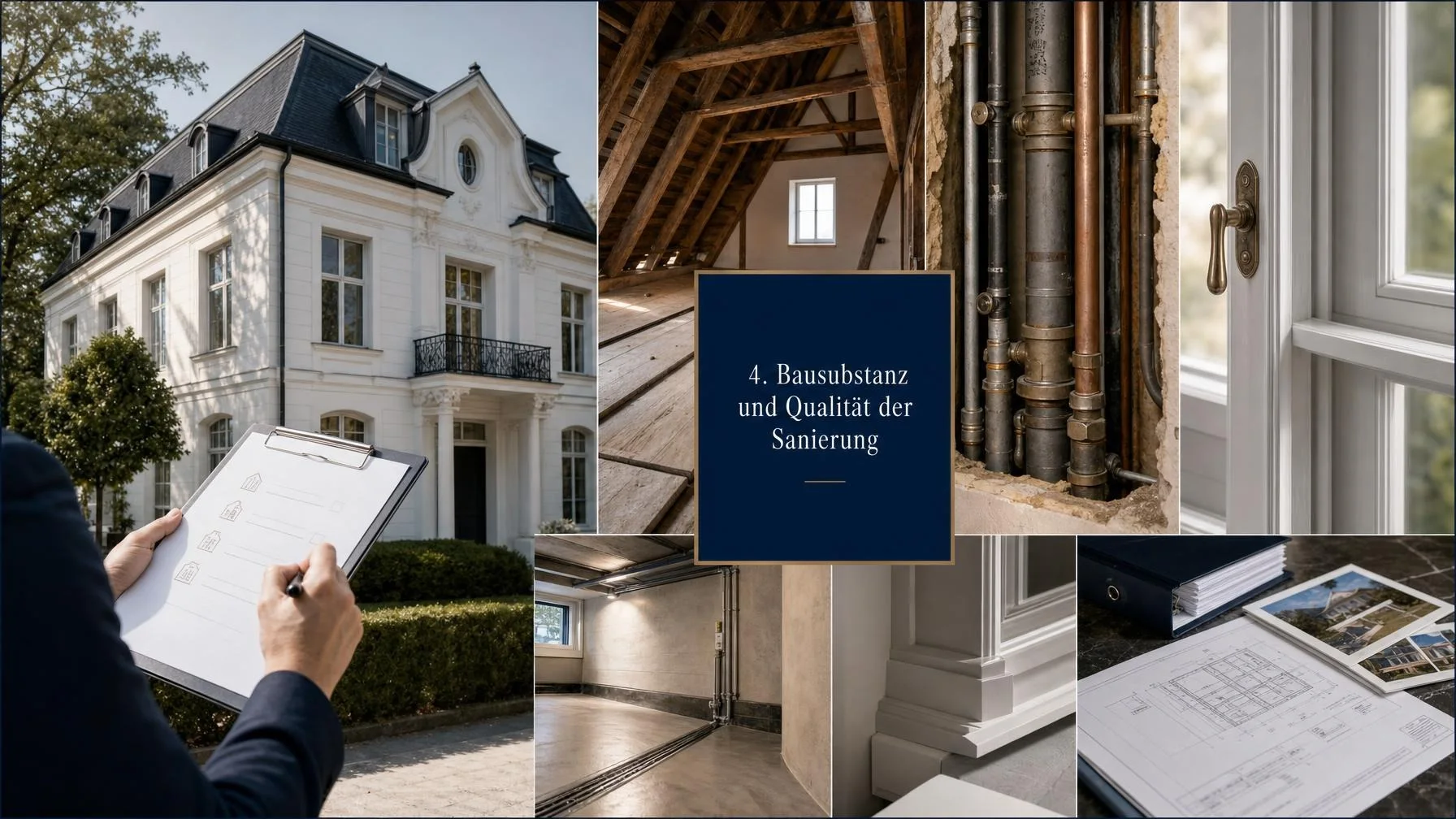
A technical inspection should cover the roof, exterior walls, windows, waterproofing, structural framework, building services, and critical junctions. In the case of basements, special attention should be paid to moisture, drainage, and the space’s actual suitability as living, wellness, or storage areas. Older villas often consist of multiple construction phases. An addition built in the 1980s may have different vulnerabilities than the main house, which was built in 1910.
Not every renovation increases the market value by an amount equal to its cost. Invisible improvements, such as new risers or professional roof waterproofing, provide peace of mind but rarely make a spectacular impression. That is precisely why they are valuable. Buyers would rather pay for documented peace of mind than for shiny surfaces covering unknown technical issues.
- Request invoices, plans, maintenance records, and contractor certificates.
- Distinguish between cosmetic renovations, technical upgrades, and complete structural renovations.
- Verify that changes requiring approval have, in fact, been approved.
- Be sure to set aside extra parts in case some components cannot be opened during the initial inspection.
A high-quality renovation is evident in the joints, seams, hardware, and technical details—not in the name of the natural stone. From there, the eye inevitably turns to the floor plan, because even perfect materials are of little use if the house gets in the way of its residents.
5. Floor Plan, Room Layout, and Practicality for Everyday Use
A house can be 500 square meters in size and still feel surprisingly cramped. Long hallways, isolated rooms, or oversized auxiliary spaces take up floor area without enhancing quality of life. A well-designed floor plan, on the other hand, makes movement feel natural: guests can reach the coat check without passing through private rooms; the kitchen and dining area flow seamlessly together; bedrooms offer tranquility; and staff or service routes remain discreet.
In Munich’s premium real estate market, a variety of lifestyles come together. Families need children’s play areas, storage space, and sturdy access points to the garden. International buyers often look for guest rooms, home offices, security features, and comfortable accommodations for domestic staff. Those who wish to have a more accessible living environment in the future consider elevators, door widths, and the possibility of a master suite on the main living level.
Flexibility enhances future-proofing. Can a library be converted into a home office? Can a guest wing be used separately? Is the basement really suitable for fitness and wellness, or does it lack natural light, sufficient ceiling height, and a suitable emergency exit? Paper is forgiving; building codes and living comfort are more stringent.
In penthouses, other key factors include the layout of the elevators, the distance between the kitchen and the terrace, and the separation of formal and private areas. In historic buildings, a renovation must not thoughtlessly disrupt the characteristic flow of spaces. An open floor plan is not a value in and of itself. Good design provides openness where interaction is desired and doors where privacy is essential.
Those who merely add up rooms overlook their dramatic effect. This dramatic effect is most powerfully conveyed through light, views, and the certainty that you yourself will not become part of your neighbors’ view.
6. Light, Views, and Privacy
Morning sun at the breakfast nook, soft northern light in the study, evening light on the terrace: These qualities don’t show up in any floor area calculations, yet they shape our daily lives. In the premium segment, the way light flows through a space can make the difference between a merely adequate property and a highly desirable home.
Don’t just consider the cardinal directions. Neighboring buildings, trees, roof overhangs, and sloping terrain all affect the actual amount of light that enters a space. A large south-facing glass wall can cause overheating in the summer if there is a lack of shading and cooling. In contrast, a supposedly dark older building can gain surprising depth through tall windows, bright rooms, and reflective garden surfaces.
When it comes to views, longevity is key. A view of Munich, a lake, or the Alps is only a reliable driver of value if building codes and surrounding properties are likely to protect it. Don’t just ask, “What do I see?” Ask also, “What could be built here in the future?” The answer determines whether you’re paying for lasting value or just a snapshot in time.
Privacy is the counterpart to the view. Floor-to-ceiling windows lose their appeal when passersby or neighbors can see inside unobstructed. Good architecture resolves this conflict through varying building heights, landscaping, louvers, or strategically placed sightlines. At the lake, another important factor is the extent to which paths, restaurants, and recreational activities impact the property.
The most valuable view is one that no one forces upon you. It combines a sense of spaciousness with a sense of seclusion. Only when both are in harmony do the interior design and materials come into their own.
7. Materials, Interior Finishes, and Precision Craftsmanship
Luxury is rarely revealed by logos. It becomes apparent when a door closes with a satisfying click, when wood grain continues seamlessly across cabinet fronts, and when natural stone slabs are cut according to their grain and pattern rather than for maximum yield. Such details create a sense of calm. They often age better than flashy trends and appeal to buyers who don’t need quality explained to them.
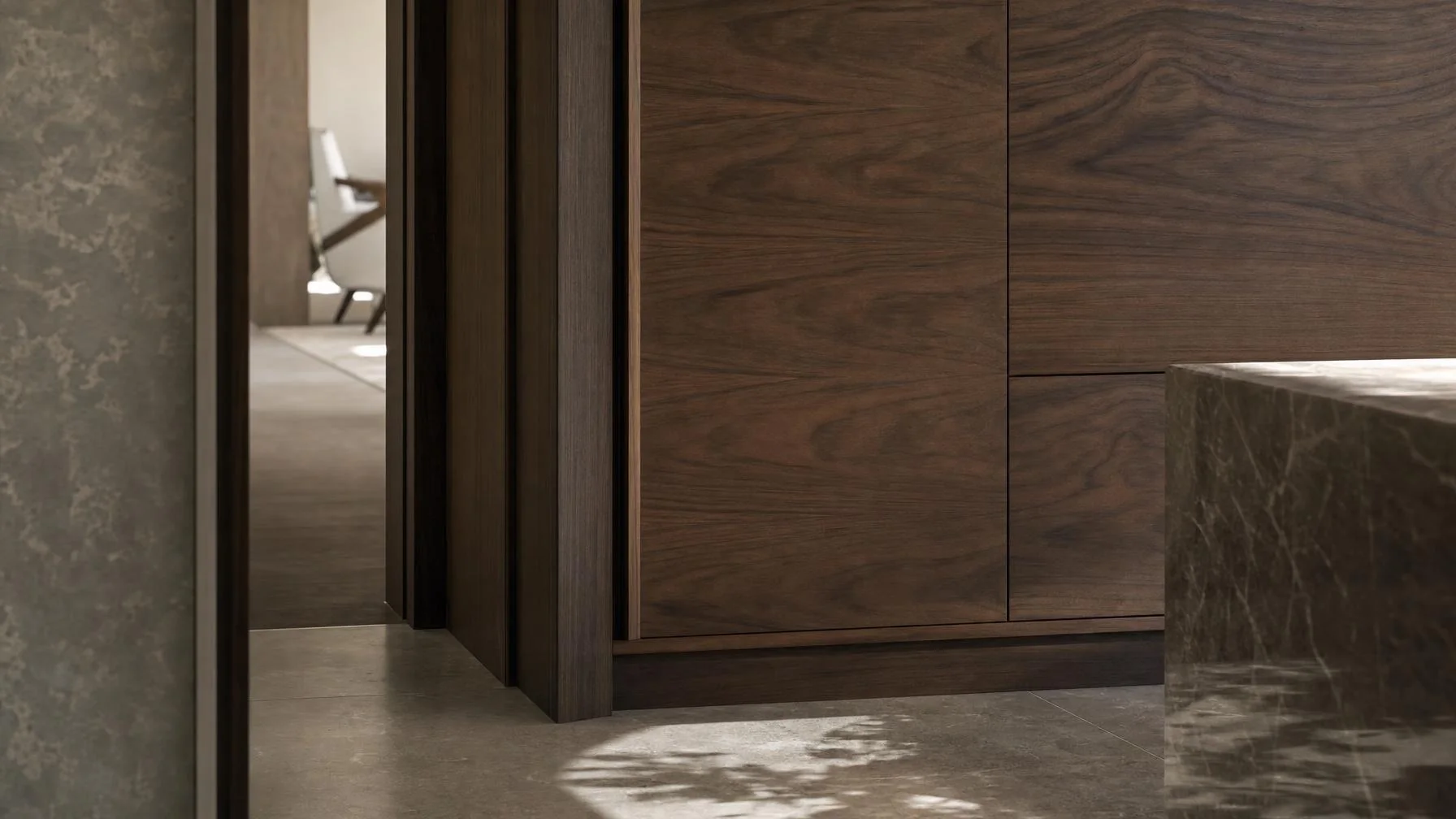
However, the valuation is not based on the original invoice amount, but rather on a combination of material quality, craftsmanship, condition, and the longevity of the design. Exotic finishes may have been expensive but still appeal to only a small target audience. Custom-built fixtures increase the value only if they remain functional and are an integral part of the architecture. In contrast, highly personalized themed rooms, dominant color schemes, or complicated lighting installations can lead to renovation costs.
Pay attention to the details: baseboards, shadow gaps, window trim, hardware, stair stringers, and transitions between materials. This is where masterful craftsmanship sets itself apart from an expensive facade. Also, check whether replacement parts and identical materials are available. A rare veneer is less impressive if even a single damaged front panel calls the entire ensemble into question.
Kitchens and bathrooms have a strong emotional impact, but trends in their design change more quickly than those in floor plans and facades. Their value should therefore not be considered in isolation, but rather in the context of the entire house. Good interior design enhances the property; poor design distracts from it.
Anyone having a luxury property appraised should therefore evaluate its features based on lasting quality rather than brand names. After all, behind elegant finishes lies another layer: the technology that ensures reliable comfort.
8. Building Systems, Security, and Discreet Comfort
The true test of a smart home doesn’t begin at the demo, but three years later. Will the shading system still work if a manufacturer updates its software? Is a local specialist familiar with the system? Can a guest turn on the lights without installing an app? Technology adds value when it’s intuitive, maintainable, and well-documented. Complexity alone only makes a fleeting impression.
In the premium segment, heating and cooling systems, ventilation, acoustics, water treatment, elevators, networking, energy management, and security must all be analyzed together. Temperature and humidity must remain controllable, especially in areas with large glass surfaces, wine cellars, wellness areas, or art collections. A server room without cooling or a pool system without accessible maintenance pathways reveals a lack of overall planning.
Security should be effective without turning the house into a fortress. Access control, alarm systems, exterior monitoring, secure refuge areas, and emergency power options may be important to certain buyers. The individual risk profile remains the decisive factor. Oversized systems result in high ongoing costs and become obsolete faster than solid structural components do.
Ask to see the system architecture, maintenance contracts, and operating concepts. Check for open interfaces, manual fallback options, and the ability to replace individual components. Ask about ongoing costs. A neat, unobtrusive equipment room with clearly labeled cables often says more about the quality of the building than the tablet on the wall.
Comfort arises when technology disappears. However, this invisibility must not obscure energy consumption—an issue that will play a greater role in purchasing decisions in 2026.
9. Energy, Operating Costs, and Long-Term Resilience
High purchasing power does not make ongoing costs irrelevant. Buyers of exclusive real estate are increasingly asking what it takes to maintain large spaces, pools, glass facades, and outdoor facilities over the long term. This is less about saving money at any cost and more about predictability, efficiency, and technical sustainability.
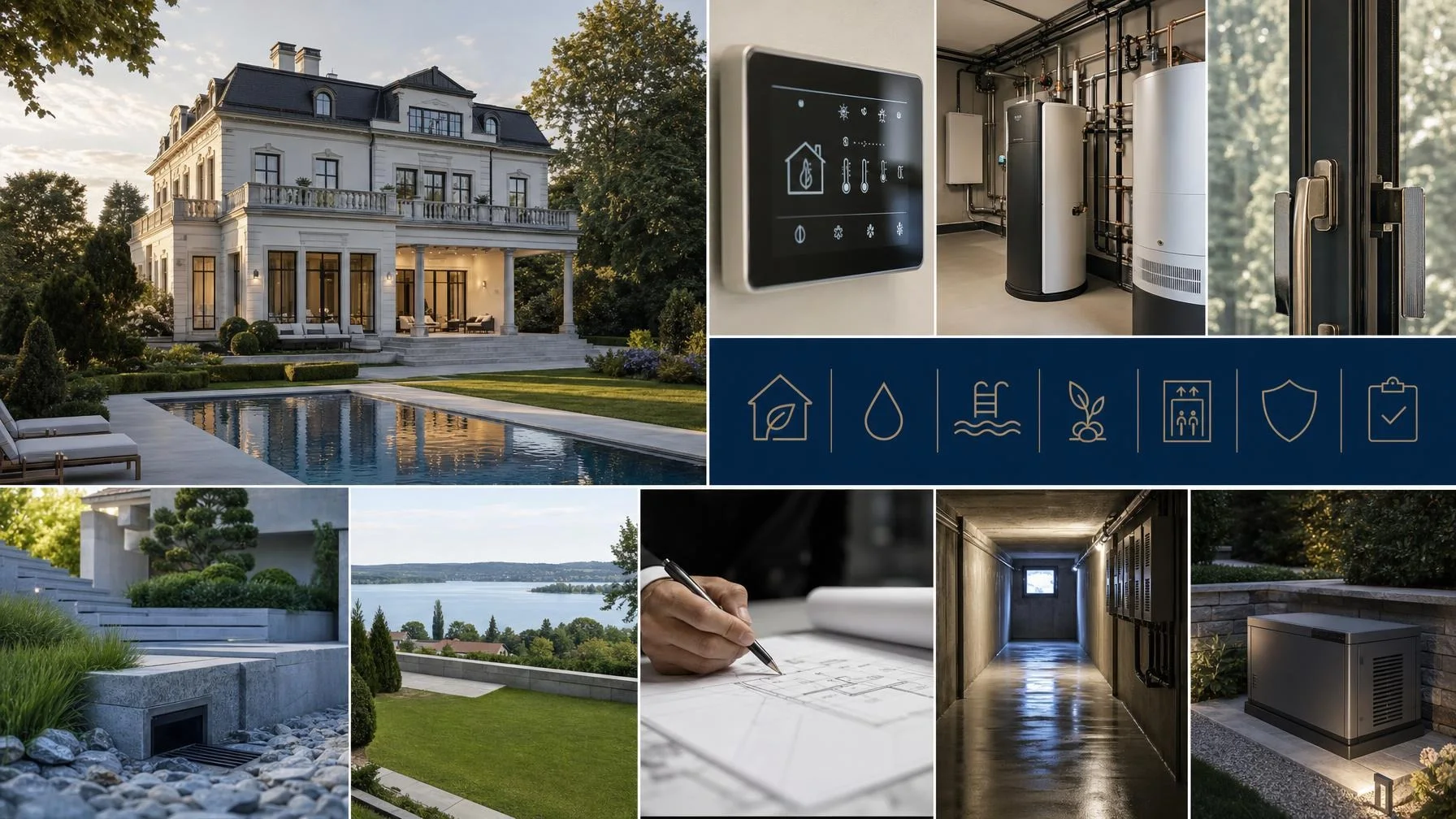
The energy performance certificate provides an initial guide but does not fully capture the complexity of a property. Key factors include the building envelope, the heating system, the control system, summer heat protection, and actual energy consumption. For historic villas, intelligent solutions are needed rather than one-size-fits-all standards: interior insulation, carefully designed window systems, or zone-based temperature control may be more appropriate than interventions that damage the building’s valuable structural integrity.
Water consumption, yard care, pool operation, elevator maintenance, security services, and maintenance contracts should also be included in the operating cost analysis. A sprawling property may require staff or specialized service providers. While these costs do not automatically reduce the property’s value, unexpected expenses can dampen a buyer’s willingness to purchase.
Resilience broadens one’s perspective. How does the house respond to heat waves, heavy rain, or power outages? Are the drainage, shading, and technical backup systems adequate? For properties on slopes or along waterways, the terrain, surface water, and sensitive basements warrant special scrutiny. Reliable conclusions require expert assessments; a dry basement on the day of the inspection is not sufficient.
A home that is energy-efficient does not automatically mean it is luxurious. However, an extraordinary home with overly complex technology loses some of its appeal. Value is created when comfort, preservation of the building’s integrity, and responsible operation come together. For this to happen, though, the legal framework must also be in place.
10. Building Regulations, Permits, and Legal Clarity
The sunroom is flooded with light, the attic has been generously converted, and the spa area has been professionally photographed. But have these spaces been approved and are they permitted as living space? In the premium segment, unclarified renovations can pose significant risks. Buyers are not only purchasing rooms, but also their legal status.
The following must be reviewed: the land register, cadastral map, building records, public law obligations, easements, historic preservation status, and, if applicable, the declaration of division and the community bylaws. For parcels of land, rights of way, utility rights, and development potential play a central role. A large parcel of land can increase in value if further development is legally possible. Conversely, the very fact that it cannot be subdivided can help preserve the character of a protected villa district.
When it comes to penthouses, special rights of use, roof areas, elevator access, and structural alterations to common property require particular attention. A terrace for exclusive use must be documented just as thoroughly in legal terms as its area is described in the property listing. For lakeside properties, additional considerations include shoreline strips, rights of use, and issues related to water law.
Legal clarity creates a value that is rarely photogenic: transaction certainty. Complete documentation shortens due diligence processes, facilitates financing, and reduces the room for negotiation that arises from uncertainty. If documents are missing, the valuation should not rely on assumptions but rather develop scenarios: approved assets, assets requiring clarification, and potential demolition or retroactive approval costs.
This level-headed approach protects you from costly surprises. At the same time, it helps you distinguish true rarity from mere marketing hype.
11. Rarity and the Realistic Range of Comparables
“One-of-a-kind” is one of the most popular words in real estate advertising. True rarity, on the other hand, can be specifically defined. Perhaps a property combines a secluded park setting with proximity to downtown Munich. Perhaps a villa on Lake Starnberg has legally guaranteed access, an exceptionally wide lakeshore, and a high degree of privacy. Perhaps a penthouse in the old town offers an elevator, spacious outdoor areas, and unobstructed views—a combination that is virtually impossible to replicate.
Rarity does not stem from a single feature, but rather from the rare combination of several qualities. A beautiful lake view is highly sought after; a beautiful lake view with a flat garden, a discreet driveway, and good year-round accessibility is significantly rarer. This combination can justify a premium, provided there is a suitable group of buyers who are actually looking for it.
In 2026, property owners should keep a close eye on the available supply. When buyers can consider several high-quality alternatives, interchangeable features lose their pricing power. Irreplaceable characteristics—micro-location, lot, view, and compelling architecture—remain distinguishing factors, however. Asking prices for competing properties provide only clues; they do not prove the actual terms under which sales are concluded.
When making comparisons, the quality of the location, the condition of the property, the lot, the legal status, and the timing of the sale must be taken into account and appropriately adjusted. A transaction brokered discreetly may be virtually invisible to the public; consequently, the data set remains incomplete, particularly in the luxury segment. Local market experience is therefore of great value.
Rarity does not justify exorbitant prices. It broadens the potential price range if the item is desirable, credibly documented, and accessible to the right target audience. This brings the emotional aspect of valuation to the forefront.
12. Target Audience, Presentation, and Marketability
A property does not have an abstract premium value that exists independently of its potential buyers. A meticulously restored mansion appeals to a different audience than a minimalist villa with an art storage area and controlled lighting. The more clearly the property identifies its ideal target audience, the more precisely its market position can be determined.
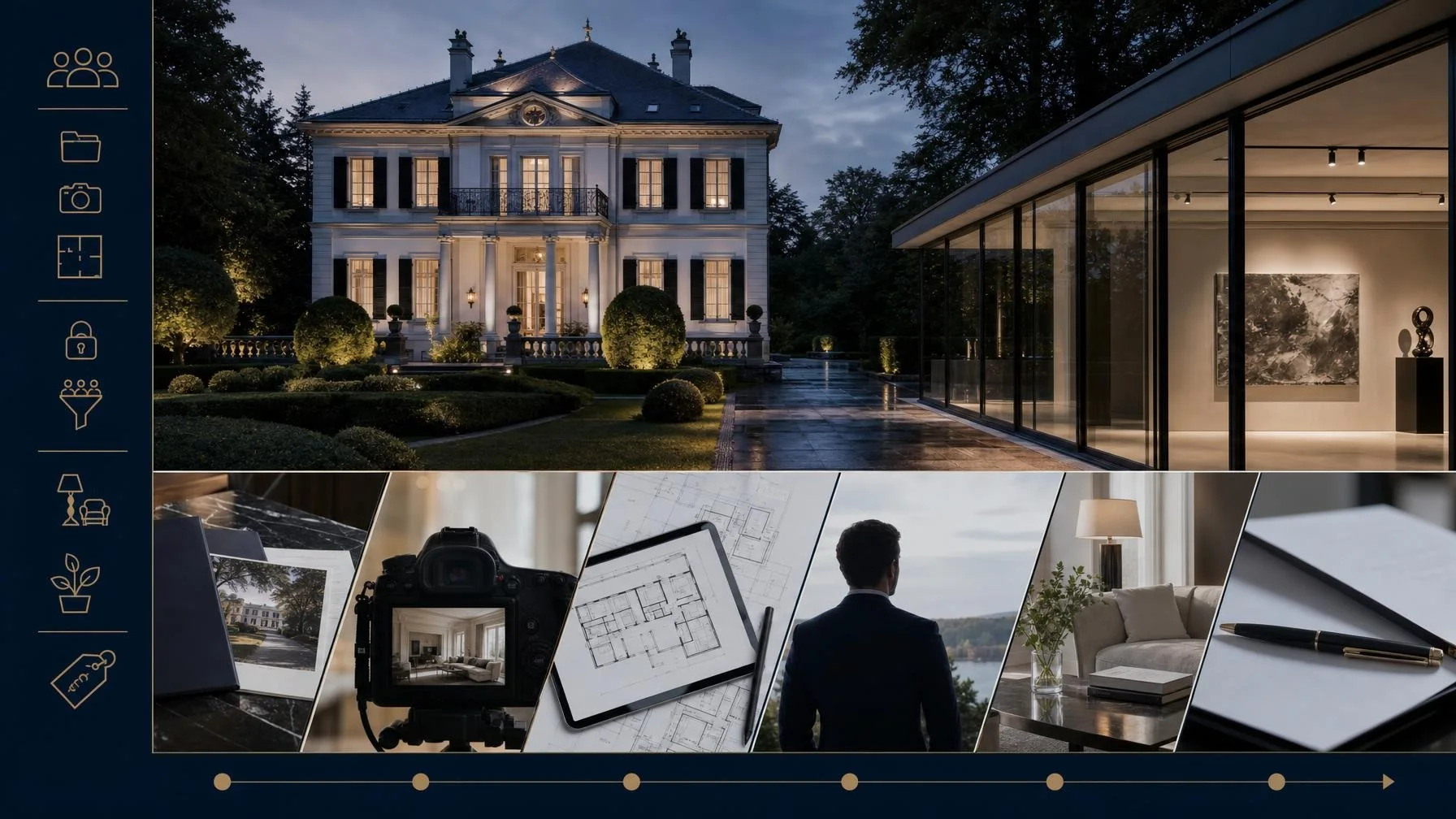
Marketability begins long before the listing is published. Complete documentation, professional photography, detailed floor plans, and a careful presentation of the property’s unique features build trust. In the luxury segment, discretion is also key. Not every property benefits from maximum visibility. A phased approach—starting with targeted direct outreach, followed by broader marketing if appropriate—can better balance the owner’s interests with market reach.
Staging does not mean concealing flaws. It organizes perception. Lighting, furnishings, landscaping, and clearly defined room functions help prospective buyers understand the property’s potential. Cluttered rooms, personal collections, or unclear uses make it difficult to appreciate the space. However, empty rooms are not automatically more elegant; large spaces quickly lose their impact without a sense of scale.
Price also influences perception. Setting the asking price significantly too high does not necessarily create a sense of exclusivity. It can deter qualified buyers, prolong the time on the market, and draw unnecessary attention to subsequent price reductions. Anyone looking to appraise and sell a luxury property should therefore clearly distinguish between market value, the strategic asking price, and their personal minimum price expectation.
A confidential initial assessment by a specialized luxury real estate agent can help identify comparable properties, target audiences, and marketing channels. Bayern Sotheby’s International Realty offers a discreet, advisory-based approach in Munich, the surrounding area, and select locations throughout Bavaria. The first step doesn’t have to be a listing agreement. Often, a structured discussion is enough to separate assumptions from reliable facts.
Conclusion: The true value lies in the synergy
An exceptional location cannot fully compensate for a weak concept. Perfect building services are no substitute for a compelling floor plan. And spectacular interior design quickly loses its appeal if privacy, permits, or sustainability are lacking. The twelve value drivers do not function like individual line items on a bill. They either reinforce or limit one another.
Anyone looking to appraise a luxury property in Munich or Bavaria in 2026 should therefore think in terms of scenarios. What is the property’s value in its current condition? What investments would remove genuine barriers to purchase? Which features are irreplaceable—and which are simply expensive? These questions lead to a more realistic range than a flat price per square meter.
Start with the enduring factors: location, lot size, building rights, architecture, and views. Next, examine the property’s condition, floor plan, building systems, and operational aspects. Only then should you evaluate the features, rarity, and the appropriate marketing strategy. Document the strengths just as thoroughly as the risks. In the premium segment, buyers are not swayed by grandiose promises, but rather by the rare combination of beauty and certainty.
That is precisely where the key value driver lies: A large house has a lot to offer. A prestigious property, on the other hand, gives the impression that it could exist only in this location, on this lot, and in exactly this form.