
The driveway disappears behind a grove of old trees. From the house, the lake glistens through the gap between two properties. But the supposedly private access ends at a seawall whose legal status is unclear. A few kilometers further on, a modestly presented villa has neither a boathouse nor a picture-perfect view. Instead, it offers tranquility, evening light, a clear driveway, and rooms that are appealing even on a gray November day. Which property is the better choice?
Who evaluates real estate on Lake Starnberg is never just buying living space and a view. They are making decisions about daily routines, commutes, privacy, architectural possibilities, and a location whose character can change within a few hundred meters. This 2026 guide categorizes the differences between Starnberg, Berg, Tutzing, Feldafing, and Possenhofen. It is not a substitute for an individual legal, technical, or tax review. However, it provides a robust framework. This framework allows one to distinguish between attractive visions of sustainable living quality. At the same time, it shows how to prepare for a discreet purchase without sacrificing due diligence for the sake of confidentiality.
Quality Over Label: What Matters in 2026
The name of the lake opens a door, but it doesn’t determine the decision to buy. Two villas listed in the same location can differ significantly in terms of noise, light, accessibility, neighborhood, and usability. Even the term “lakefront” remains vague. It can refer to a waterfront lot, an unobstructed view from an elevated vantage point, or simply proximity to a public section of the shore.
For 2026, therefore, it is not the most sensational market forecast that deserves attention, but the quality of the analysis. Prices, market conditions, and sellers’ willingness to sell are changing. Without reliable property or transaction data, sweeping statements would be unfounded. More consistent are the factors that shape a home on a daily basis: the orientation of the living spaces, the topography, the relationship to the street, the legal status of access, and the question of whether the building fits one’s personal life plans.
A robust search profile distinguishes between three levels:
- Essential features: for example, suitability as a permanent primary residence, access to rail service, barrier-free access, or guaranteed access to the lake.
- Valuable features: mountain views, a boathouse, historic architecture, a guest house, or a spacious garden.
- Non-essential features: Characteristics that look impressive in the property listing but are of little practical use in everyday life.
This hierarchy prevents a minor detail from obscuring the big picture. Scarcity does not make every object suitable; rather, it makes a precise decision all the more important.
What Sets a True Lakeside Location Apart from Merely Being Near a Lake
A true waterfront location doesn’t begin at the patio door, but in the legal documents. What matters is whether the property borders the water directly, how the boundary runs, and what rights actually exist. A dock, a buoy, a boathouse, or a historic staircase may have been visible for decades. This does not automatically mean that every structure may be used, renovated, or expanded without change.
Four terms that buyers should evaluate separately
- Direct lakeside location: The property borders the lake directly. However, the property lines, shoreline reinforcement, and permitted uses must still be verified.
- Secured Access to the Lake: Access may be provided through one’s own property or through a right in rem. The scope and conditions of the right are decisive.
- Lake view: The view can be impressive, but it says nothing about access to the water. Ensuring access in the long term must also be evaluated separately.
- Proximity to the lake: The lake is within easy reach. However, roads, railroad tracks, public paths, or private property may lie between here and the lake.
Access to water, ownership of the shoreline, and rights of use must be examined separately. Relevant factors include property boundaries, easements, permits under public law, water law requirements, and potential third-party rights. Accessibility to the shoreline from within the property is also a factor. A steep slope or numerous steps can significantly reduce the practical value of what is, in theory, private access.
In addition to legal considerations, there is the issue of spatial quality. Many lots on the east shore face west and can offer long afternoons and striking evening atmospheres. Depending on their orientation, locations on the west shore benefit more from the morning sun. There, the lake and the Alps can create a striking interplay. Such rules of thumb are no substitute for an on-site visit. Trees, neighboring houses, changes in terrain, and coves can completely alter the effect.
Also consider what happens between your home and the water. Waterfront paths, swimming areas, restaurants, boat docks, or seasonal recreational traffic can affect your privacy. A lively waterfront can be enriching if you prefer short distances and social proximity. Those seeking seclusion, however, view these same factors differently. The best waterfront location is therefore not necessarily the one closest to the water. What matters most is whether its legal and physical reality fits your lifestyle.
Why the micro-location Trumps the Place Name
Macro-locations help with the initial screening. However, the actual purchase decision is made based on the micro-location. This includes the specific stretch of street, the elevation, the surrounding buildings, the background noise, and all the routes one would typically take on a normal day. When purchasing real estate on Lake Starnberg, this factor should be given the same weight as architecture and lot size.
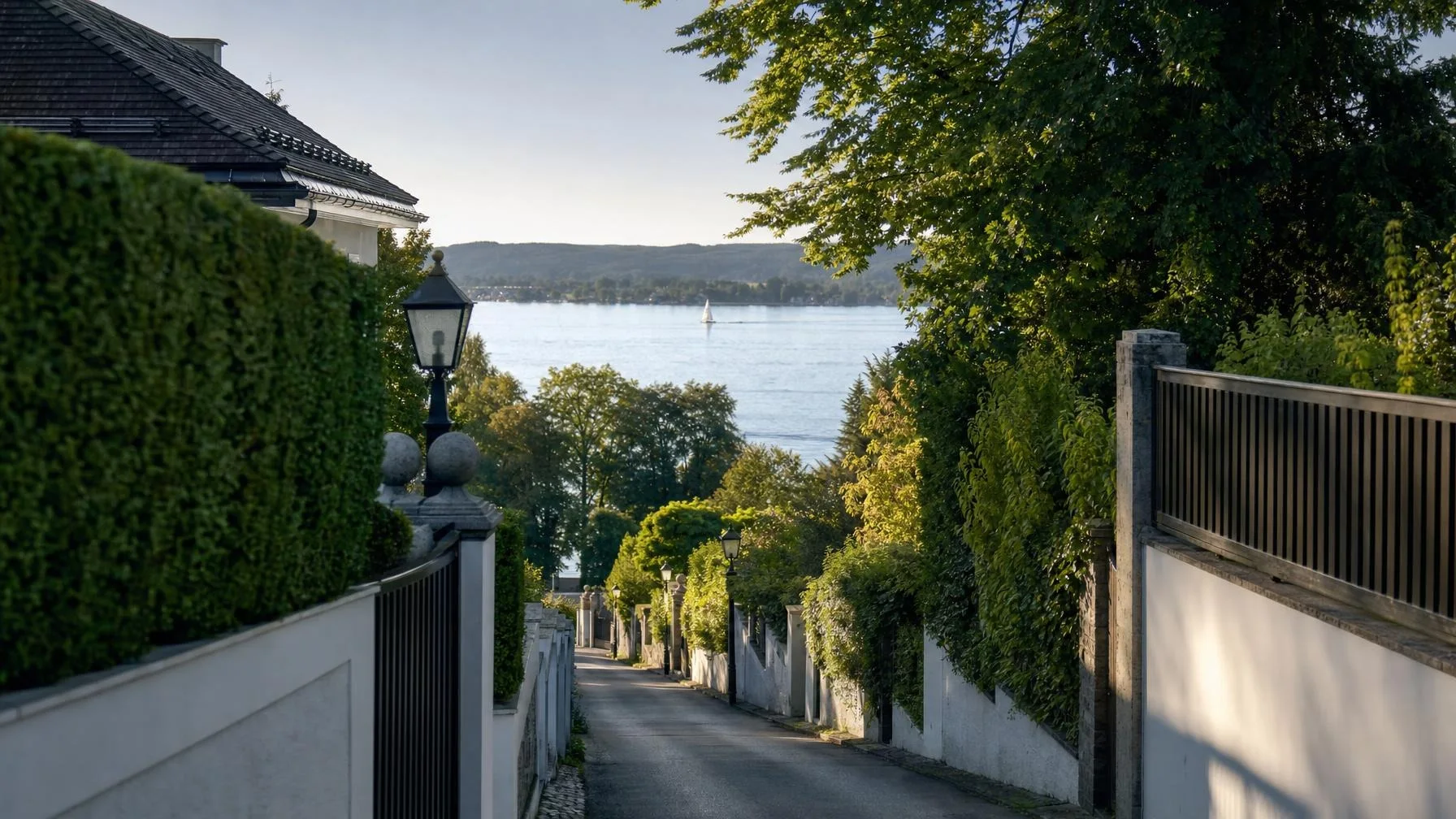
A meaningful tour therefore begins at the garden gate. How wide is the driveway? Can guests turn around? Where do delivery vehicles park? Is the patio sheltered, or can every conversation be heard on the neighboring property? With the windows open, can you hear traffic, trains, boats, or recreational activities? A single visit in the late morning can only answer some of these questions.
Four dates for a realistic picture
- Weekday mornings: Commuter traffic, children on their way to school, and the actual trip to the train station or the main transit hub become visible.
- Late afternoon: Light, rising temperatures, commuters heading home, and people enjoying neighboring gardens all change the atmosphere.
- Weekend: Day-trip traffic, waterfront activity, and recreational noise reveal a different side of the situation.
- Unfavorable weather: A house that holds its own in the rain, wind, and flat light usually has more everyday appeal than a property that only looks good under a blue sky.
Then there is the question of future prospects. Undeveloped neighboring lots, large gardens, and unobstructed views have a lasting impact, but this is not necessarily the case. Planning regulations, lot configurations, and potential structural changes must therefore be included in the site analysis. Today’s unobstructed view should never be taken for granted as a feature of tomorrow.
Starnberg: Urban Proximity at Different Speeds
Starnberg is ideal for buyers who do not view the lake as a retreat from all aspects of daily life. The city combines local amenities, schools, medical services, restaurants, and rail connections with proximity to the northern shore of the lake. This density makes everyday life easier, where appointments in Munich are just as much a part of life as an evening by the water. However, it also brings with it activity, traffic, and a vibrant public life.
Within Starnberg, very different residential environments lie in close proximity to one another. Central locations shorten travel distances. At the same time, they require a careful assessment of road layouts, rail connections, and visitor traffic. Elevated residential areas can offer tranquility, sunshine, and views. A spontaneous walk to the waterfront often takes longer there. In Percha, the connection to Munich and the proximity to the water play a different role than in secluded hillside locations. In Söcking, the distance from the immediate lakeshore can be offset by a unique, green living environment.
For decision-makers, the key question is: How much urbanization can the lake handle? Those who want to get to the train in the morning without a long commute, run errands all at once, and entertain guests with ease may value proximity to the city center more than absolute seclusion. Those seeking tranquility must be more selective. A city address does not automatically equate to a quiet micro-location.
Even views can be deceiving. An elevated lake view creates a strong sense of space. However, a hillside lot poses additional challenges regarding access, yard maintenance, drainage, and barrier-free living. In Starnberg, a single feature rarely tips the scales. Quality stems from the balance between accessibility and seclusion.
Berg: Retreat along the eastern bank and deliberately planned routes
Berg and its neighborhoods appeal to buyers seeking a quieter, more scenic side of the lake. Properties in Berg, Kempfenhausen, Leoni, or Ammerland each have their own unique character. Some areas are located directly on the water, while others are situated on higher ground or behind mature greenery. The community, therefore, cannot be reduced to the image of a consistently secluded lakeside setting.
The east bank offers stunning views toward the west and long, beautiful sunsets. Yet it is precisely here that we see how strongly vegetation and topography influence what might seem to be an advantage. A dense stand of trees provides privacy but blocks light. An open hillside location expands the horizon, but it may also be more exposed to view or to the elements. Good architecture responds to these conditions rather than fighting against them every day.
Compared to locations near rail lines on the west bank, Berg often requires a more thoughtful approach to organizing mobility. Commutes to workplaces, schools, airports, or train stations should not be evaluated based on idealized map measurements. What matters is the actual weekly routine. For households with multiple vehicles, a designated driver, or predominantly flexible work arrangements, the assessment differs from that for family members who are expected to get around on their own.
Privacy, moreover, does not depend solely on the size of the lot. Narrow roads along the shore, neighbors’ driveways, or houses situated on higher ground can create lines of sight, even if the property appears secluded. Berg rewards buyers who are not merely looking for “Ostufer.” What matters most is the specific relationship between the house, the landscape, and the daily routine.
Tutzing: A Self-Sufficient Hub of Life in the South
Tutzing feels less like a suburb of Munich and more like a self-contained community by the lake. The town combines rail access, local amenities, schools, medical facilities, and cultural life with a strong connection to the water. For buyers who want to live there year-round, this sense of independence may be more important than the short distance to downtown Munich.
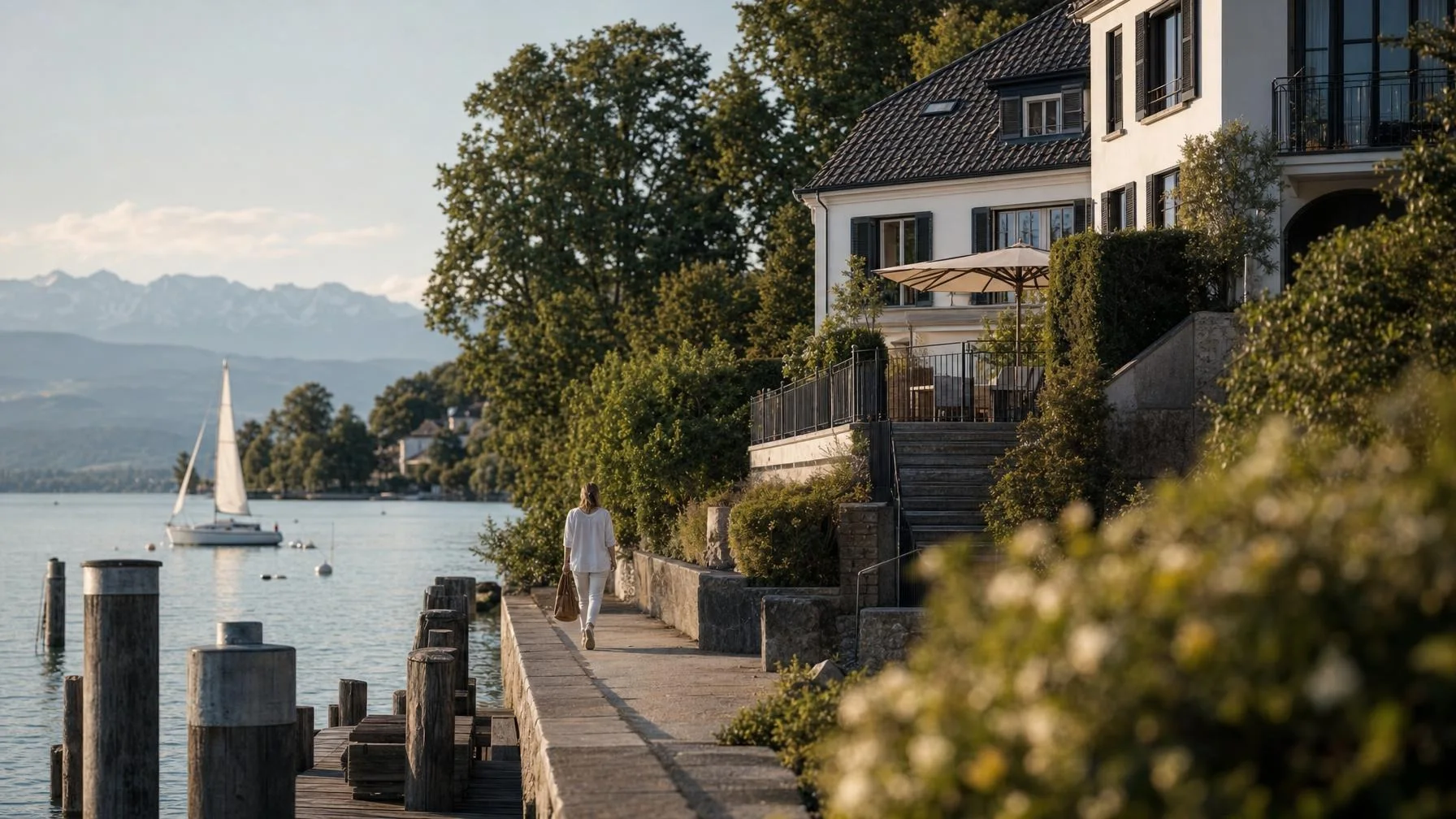
The locations range from central and within walking distance to quiet and elevated. Homes near the shore benefit from short distances. At the same time, they are close to public life and seasonal activities. With the right orientation, hillside locations can offer sweeping views of the lake and the Alps. However, they require careful consideration of access roads, stairs, drainage, and daily access to the town center.
Architecturally, Tutzing is a blend of historic villas, established residential buildings, and contemporary additions. This mix lends the area character but also increases the need for careful evaluation. With older homes, it’s not just the roof, windows, and building systems that matter. Ceiling heights, natural light, moisture levels, energy-efficiency measures, and potential historic preservation requirements all determine whether a vision can be realized in a way that makes economic and design sense.
This town is particularly well-suited for people who don’t view the lake merely as a backdrop. Sailing, walks, dining out, and connecting with locals can all become part of a typical day. On the other hand, anyone seeking maximum anonymity or who needs to travel regularly to destinations north of Munich should carefully consider the commute. Tutzing’s strength lies in its vibrant everyday life. This is what sets the town apart from a mere weekend getaway.
Feldafing: Greenery, Villa Culture, and Thoughtfully Chosen Proximity
Feldafing has a tranquil character, defined by mature trees and historic villa architecture. The lake, parklands, the Rose Island, and expansive green spaces shape the town’s landscape. But even here, the ZIP code isn’t the deciding factor. In everyday life, the distances between the train station, the town center, the lakeshore, and residential streets can feel greater than a map would suggest.
For many buyers, the appeal lies in the balance between scenic beauty and access to rail service. Anyone looking for this combination should actually walk the routes themselves: in the dark, in the rain, and with luggage. A house may be nominally close to the train station but still be impractical due to hills, street crossings, or roundabout routes. Conversely, a slightly set-back location can work surprisingly well.
Existing trees require attention. Large trees provide shade, privacy, and an atmosphere that cannot be recreated overnight. At the same time, they affect lighting, roof maintenance, moisture levels, and expansion possibilities. Tree protection, root zones, and traffic safety must be considered early in the planning process, not just after the purchase.
Feldafing is ideal for buyers who appreciate a prestigious, peaceful setting without ostentatious displays. Historical references and a refined environment contribute to the quality of life here. However, they are no substitute for a technical inspection. Especially in the case of characterful homes, a renovation should respect the existing structure while thoughtfully integrating modern comforts.
Possenhofen: A Historic Atmosphere Between the Water’s Edge and the Hillside
Possenhofen is part of the municipality of Pöcking, yet it has its own distinct identity. Its historical ties, the surroundings of the castle, its proximity to the river, and its rail connection shape how it is perceived. The location appeals to buyers who seek scenic and cultural depth without wanting to give up access to Munich.
The micro-locations differ primarily in terms of elevation and proximity to public spaces. Areas near the shore offer a direct connection to the lake. However, they can also attract walkers, swimmers, and seasonal visitors. Elevated lots create distance and potential views. In turn, this makes the path to the water less casual. Between these two extremes lie quiet residential streets whose true character can only be fully appreciated by walking through them.
When it comes to historic buildings and properties located within significant architectural ensembles, planning regulations warrant special attention. Not every contemporary addition, large-scale glazing project, or garden redesign will be approved. Consulting with expert architects and the relevant authorities early on can help prevent a purchase where the intended use later runs up against building restrictions.
Possenhofen is not a compromise between Starnberg and Tutzing, but a choice in its own right. The town suits a lifestyle that combines history, rail access, and nature trails. Those seeking complete privacy should take a particularly close look at the specific neighborhood.
East Bank or West Bank: A Matter of Daily Rhythm
The choice between the east and west sides is often reduced to a choice between a sunset view and a view of the Alps. That sounds elegant, but it’s only helpful to a limited extent. Orientation, slope, vegetation, and surrounding buildings override any general rule. A more meaningful question is: at what time of day should the house showcase its most important rooms?
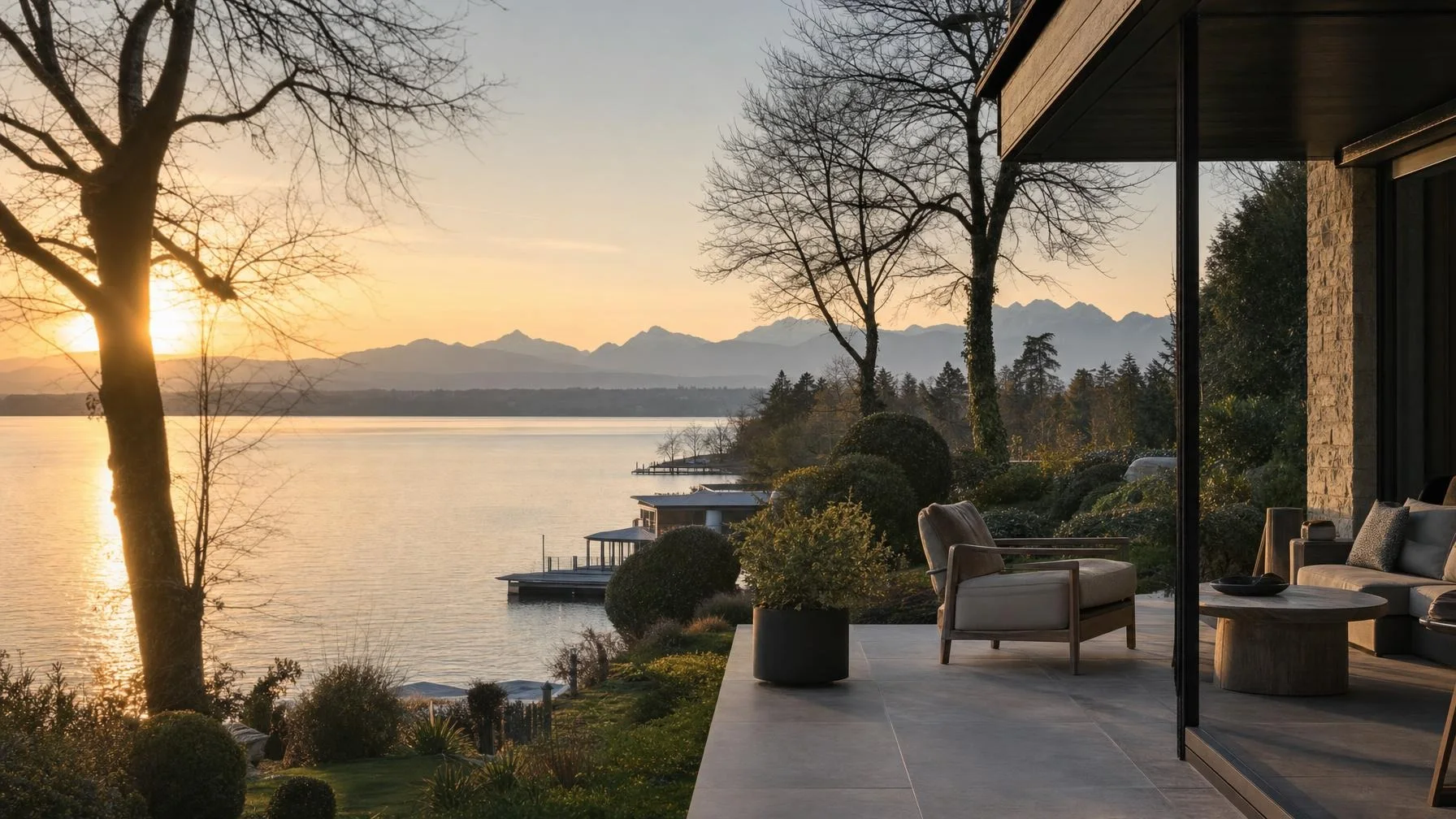
People who start their day early and make frequent use of breakfast patios perceive morning light differently than those whose family life shifts to the garden in the late afternoon. A home office may require even lighting. Living and dining areas, on the other hand, can benefit from a warm evening ambiance. Bedrooms, pools, artwork, and delicate materials each have their own specific requirements when it comes to sunlight and shading.
Transportation dynamics also differ. Depending on the specific address, locations on the west bank with train stations offer a different level of independence from cars than many locations on the east bank. There, spacious living environments and scenic tranquility can justify the greater organizational effort. The key factor remains who in the household makes which trips. The commute time of the primary decision-maker alone rarely provides a complete picture of family life.
A Compact Decision Matrix
- Prioritizing the West Bank: when access to rail service, independent community structures, and morning sun are especially important.
- Prioritizing the East Bank: when seclusion, western views, and a daily life organized around the car fit one’s lifestyle.
- Consider both sides: when privacy, architecture, and the quality of the property are more important than a predetermined place name.
The best part of the lake isn't shown on the map. It reveals itself on an ordinary Wednesday.
Architecture, Existing Structures, and the Hidden Risk of the Renovation Plan
On Lake Starnberg, there are houses whose value stems precisely from their history: proportions, artisanal details, old gardens, and spaces that have evolved over decades. Alongside them are clean, contemporary buildings that precisely frame the landscape and light. Both types can be compelling. The problem arises when buyers treat existing properties merely as placeholders for an untested vision.
Before purchasing, you should determine whether the building is protected, part of a historic ensemble, or subject to local ordinances and zoning regulations. Setback requirements, permitted uses, number of stories, buildable areas, and parking spaces also affect expansion plans. For waterfront properties, additional requirements under environmental and water laws may apply. The existence of an existing boathouse or dock does not automatically entitle the owner to construct a new structure of the same design.
From a technical standpoint, slope runoff, groundwater, moisture, drainage, and retaining structures deserve special attention. Added to this are the potential effects of heavy rainfall. Large glass surfaces can open up impressive views. However, they can also lead to overheating in the summer or a lack of privacy. Basements on slopes often appear to be full stories when viewed from the garden, but they present their own challenges in terms of building physics.
A smart evaluation process therefore does not begin with color samples, but with a feasibility range. An architect, a technical expert, and—if necessary—other specialized planners should assess what can be preserved, improved, or modified in a way that meets regulatory requirements. Only then will it become clear whether a house can be adapted to one’s lifestyle with a reasonable amount of work, or whether the desirable location will necessitate a lengthy renovation.
Privacy cannot be measured in square meters
A large property can be surprisingly exposed. A smaller one can offer complete seclusion thanks to the terrain, architecture, and landscaping. Privacy by the lake is created through sightlines, sounds, paths, and the choreography of arrival. It begins where a vehicle leaves the public road and does not end at the hedge.
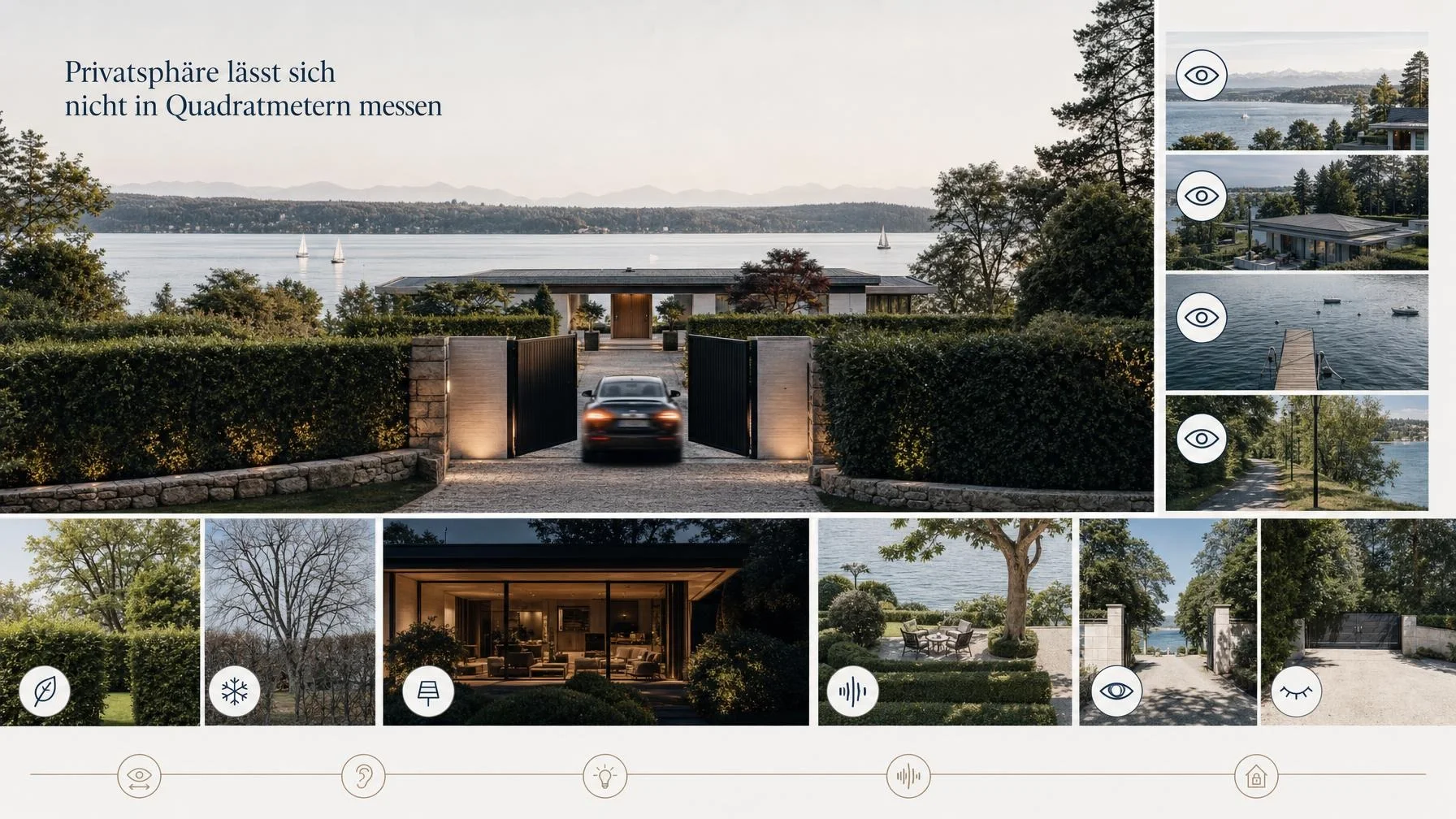
Check for visibility from neighboring houses, from higher-lying properties, from the water, and from public paths. In the summer, foliage provides greater privacy. In the winter, this screen disappears. That’s why the months when the trees are bare often provide a more accurate assessment. Lighting also changes the situation. Living spaces with large windows can look like stages after dark.
Acoustics play an equally important role. Water carries voices and engine noise differently than one might expect based on distance alone. Hedges do little to block sound. Walls, landscaping, the placement of buildings, and the orientation of outdoor areas are more effective. Anyone seeking quiet should therefore listen at several points in the garden. The sheltered reception area alone is not representative.
Discretion also applies to the address itself. A well-known mansion may carry social prestige, but it can also attract attention. Some buyers seek precisely this kind of historical visibility. Others prefer a home whose quality becomes apparent only once you step through the gate. Both approaches are valid. The desired level of visibility should be defined before beginning the search.
Infrastructure and Connectivity Without Overly Optimistic Projections
Distances by the lake seem short on a screen. In everyday life, however, bottlenecks, school start times, construction zones, recreational traffic, and the route from the property to the main road all matter. A sound decision about a location, therefore, does not rely on an ideal travel time. It takes into account a range of realistic routes.
Starnberg offers a well-developed local infrastructure and direct access to Munich. Tutzing also has an important rail connection and its own local services. Feldafing and Possenhofen connect residential areas with train stations. The actual distance and topography remain decisive factors here. Berg is organized more around road connections and neighboring centers or train stations. This classification is intentionally qualitative. Timetables, traffic conditions, and individual destinations alter the actual journey.
A weekly schedule is a good idea for families and executives. It takes into account the office, the airport, schools, sports, medical appointments, shopping, and evening events. Then you can determine which routes are realistically feasible on foot, by train, by bike, by car, or via a ride-sharing service. A home that’s perfectly connected for one person can create daily dependencies for the rest of the household.
Infrastructure also includes digital and technical services. Internet access, cell phone reception, charging infrastructure, road widths, and snow removal services are not available everywhere at the same level of quality for properties in remote locations. In this context, living comfort is not reflected in visible amenities. It is reflected in the fact that everyday life runs smoothly and reliably.
Recreational Value and Lifestyle Throughout All Seasons
On a summer day, Lake Starnberg practically sells itself. The smarter question is: What is the house like in February? Does the lake become a quiet expanse or just an unused backdrop? Are the walking trails easily accessible, or does every activity require a drive? Do the living spaces remain bright when the sun is low and the trees have lost their leaves?
Sailing, swimming, rowing, cycling, and hiking are key recreational activities. Not every buyer needs private access for these activities. For some, proximity to a public swimming area offers more practical use than a high-maintenance stretch of shoreline. Others prefer a discreet path from the house to the boat. In exchange, they accept higher maintenance requirements and legal scrutiny.
The right place depends on your lifestyle. Starnberg supports a more urban, connected daily life. Berg emphasizes seclusion and the countryside. Tutzing offers a distinct local community with a southern flair. Feldafing combines green spaces, villa culture, and access to rail service. Possenhofen brings together history, the lake, and nature trails in a concentrated setting. None of these qualities is objectively superior.
It’s helpful to create a mental calendar. How many weeks do you actually spend there? Do you have guests regularly? Do children and teenagers need their own means of transportation? Should the house serve as a showcase, provide a place to recharge, or do both in separate areas? These answers form a usage profile. Only then does recreational value transform into a quality of life—rather than just an occasional view.
The Discreet Purchase: Off-Market Is a Process, Not a Promise
Particularly high-end properties on Lake Starnberg are not always offered publicly. Owners may have family, social, or strategic reasons for considering a sale only within a select group. However, “off-market” does not automatically imply exclusivity or quality. The term primarily describes a confidential sales channel.
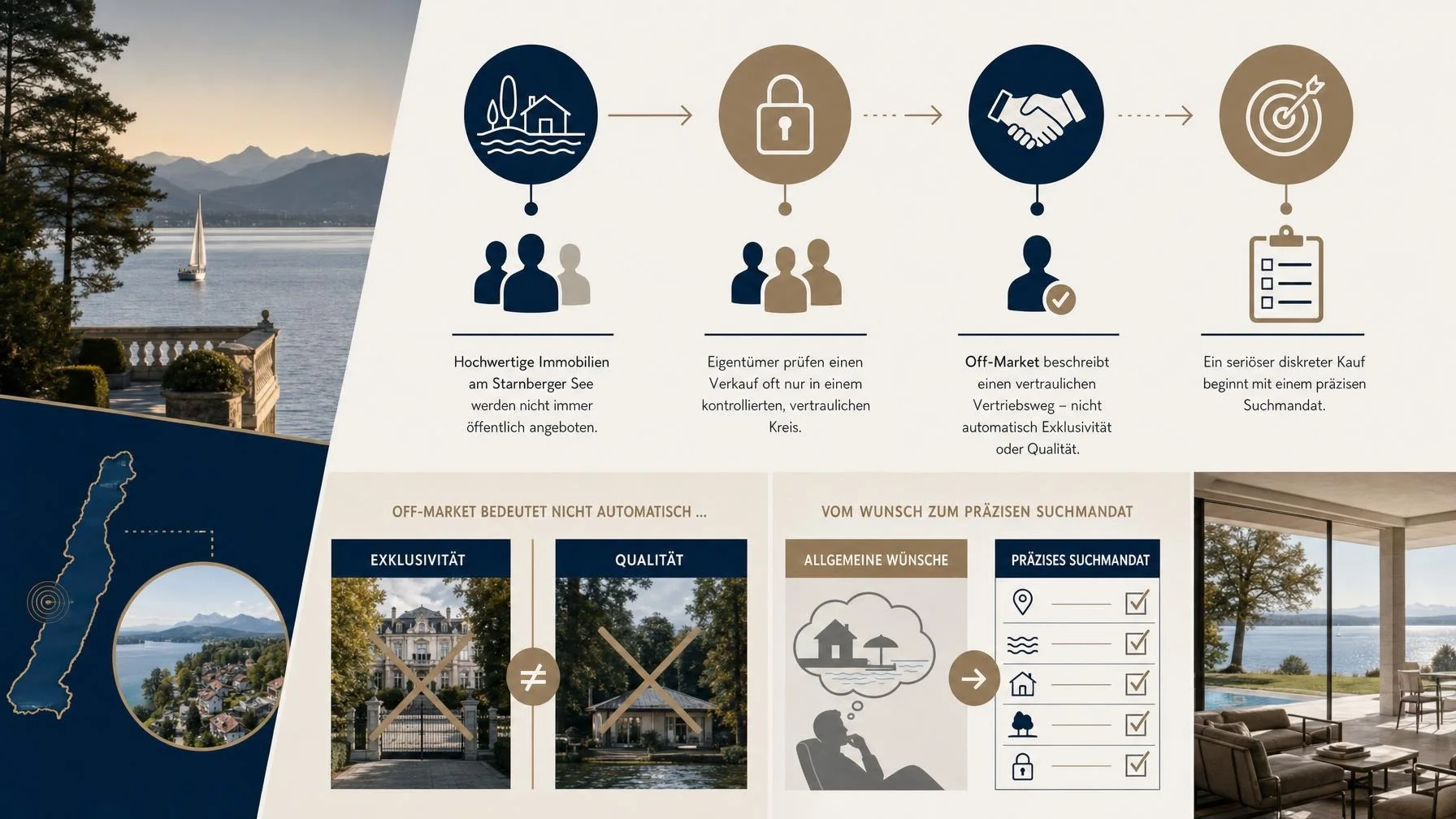
A serious, discreet purchase begins with a precise search mandate. General requests such as “villa with lake access” are not sufficient. Sellers and their advisors want to determine whether the location, budget, timeline, and intended use are a good fit. Willingness to proceed with the transaction is also a key factor. Proof of sufficient capital or creditworthiness may be required before sensitive documents or the exact address are disclosed.
Seven Steps for a Controlled Off-Market Purchase
- Search criteria: Locations, micro-locations, exclusion criteria, land use, and time frame are clearly defined.
- Qualification: Identity, decision-making structure, and financial feasibility are assessed confidentially.
- Market Access: The consultant reaches out to suitable property owners, family offices, network partners, and colleagues acting on behalf of clients in a targeted manner, without making any claims regarding availability.
- Tiered Information: Initially, anonymized key data is shared. The address and documents are provided only if there is serious interest.
- Tours: Tours are conducted under controlled conditions. Photography, accompanying persons, and communication should be arranged in advance.
- Review: Confidentiality never shortens the technical, legal, or financial due diligence process.
- Negotiation and Closing: The purchase price, inventory, closing, terms, and notarization are clearly separated from one another.
Discretion works both ways. Buyers expect their identity and strategy to be protected. Sellers expect their contact information, documents, and intent to sell to be handled with care. A robust network is valuable in this context, but it is not a catalog of invisible offers. Its quality is demonstrated by respectfully initiating appropriate conversations and ending inappropriate ones early on.
Due Diligence: From a Beautiful House to a Well-Informed Decision
When evaluating real estate on Lake Starnberg, emotion and due diligence should not work at cross-purposes. Enthusiasm reveals why a house is appealing. Due diligence determines whether that enthusiasm is justified. Both perspectives belong at the same table.
The legal review includes, among other things, the land registry, cadastral map, building encumbrances, rights of way, easements, rights of residence or use, as well as the compliance of existing structures with permits. Any potential contaminated sites and public law restrictions must also be clarified on a property-by-property basis. For waterfront properties, additional rights and permits pertaining to docks, boathouses, walls, and water access must be considered. Planning documents indicate which changes are generally feasible.
The technical inspection examines the structural framework, roof, facade, windows, building services, moisture, drainage, and energy efficiency. For sloped lots, retaining walls, ground stabilization, and surface water require additional attention. Historic buildings require experts who understand old construction methods, rather than evaluating them solely based on criteria for new construction.
Finally, there is the practical perspective. This includes ongoing maintenance costs, the garden and trees, security, property management, staff access routes, winter operations, and storage for vehicles or boats. A property may be legally sound and structurally sound. Nevertheless, it may not align with your desired lifestyle.
A concise decision paper should ultimately answer four questions:
- Which qualities are guaranteed in the long term?
- Which characteristics are based on assumptions or changing circumstances?
- What investments and permits are required for the intended use?
- Which risks can be addressed, and which are an inseparable part of the situation?
This clarity also strengthens the negotiation. It replaces blanket enthusiasm with clear priorities.
Conclusion: Making the right purchase starts with asking the right question
Lake Starnberg does not offer a single, uniform premium location, but rather a mosaic of different living environments. Starnberg combines the lake with urban infrastructure. Berg places greater emphasis on the landscape and a sense of seclusion. Tutzing stands out as a distinct center of community life. Feldafing cultivates green spaces and established villa neighborhoods. Possenhofen combines a historic atmosphere with a unique location between the lakeshore and the hillside.
Anyone looking for real estate on Lake Starnberg should therefore not start by asking which property makes the most impressive impression. The better question is: Which location will support your daily life for years to come? A well-considered answer takes into account access to the lake, privacy, natural light, access routes, architecture, zoning regulations, and the property’s physical condition. When purchasing off-market, clear communication, proven feasibility, and mutual discretion are also key factors.
Bayern Sotheby’s International Realty can confidentially develop such a search profile, identify relevant micro-locations, and guide you through the due diligence and purchase process. An initial consultation does not necessarily have to lead to a decision on a specific property. Often, it is sufficient to clearly define your priorities before a specific opportunity arises that requires a swift yet thorough evaluation.